




Pika
AI video editing and generating AI videos
Tags:Ai visual generationAI Video Creation Content Creators Pika Art Pikaframes Video Generation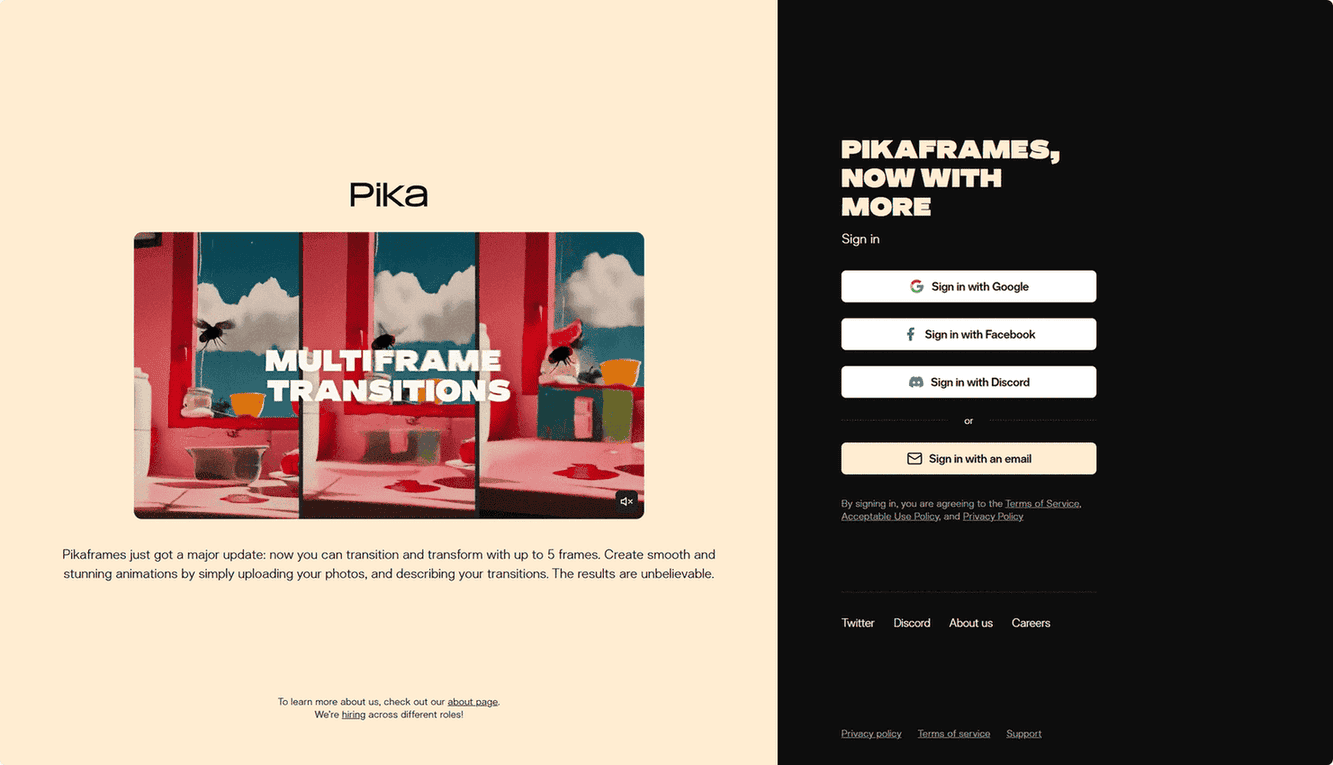
Pika Art: Democratizing Video Creation Through Innovative AI Technology
The digital landscape is increasingly dominated by video content, with platforms across various sectors prioritizing visual storytelling. However, the process of creating high-quality videos has traditionally been complex, often requiring specialized skills and expensive software. Pika Art emerges as a groundbreaking solution, an AI-powered platform designed to simplify video creation and empower individuals with or without prior experience to bring their creative visions to life. By focusing on user-friendliness and leveraging cutting-edge artificial intelligence, Pika Art aims to democratize video production, making it accessible to anyone with an idea.
The first encounter with Pika Art for any prospective user is the login page. This initial touchpoint provides valuable insights into the platform’s current focus and priorities. The prominent headline, “PIKAFRAMES, NOW WITH MORE,” immediately signals a significant update to the service. The accompanying description elaborates on this enhancement, highlighting the ability for users to “transition and transform with up to 5 frames” to generate “smooth and stunning animations.” This update emphasizes the platform’s commitment to evolving its capabilities, specifically in the realm of image-to-video animation, and the enthusiastic claim that “The results are unbelievable” aims to capture user interest.
Beyond the headline, the login page offers several pathways for users to access the platform. Multiple sign-in options, including Google, Facebook, Discord, and email, underscore Pika Art’s focus on user convenience and accessibility. By providing familiar and widely used login methods, the platform reduces friction in the onboarding process, allowing users to quickly begin exploring its features. Below these options, a clear statement indicates that by signing in, users agree to the Terms of Service, Acceptable Use Policy, and Privacy Policy, with direct links provided to each document. This demonstrates a commitment to transparency and ensures users are aware of the legal frameworks governing their use of the platform.
The footer of the login page contains a comprehensive set of links, offering further information about Pika Art. Links to their Twitter and Discord communities suggest a focus on user engagement and building a community around the platform. The inclusion of “About us” and “Careers” links provides insights into the company’s mission, values, and growth aspirations. Furthermore, readily available links to the Privacy Policy and Terms of Service reiterate the platform’s dedication to legal compliance and user trust. Finally, a “Support” link, directing to their Discord server, indicates a commitment to providing user assistance and addressing any queries or issues. The presence of this extensive information within the login page underscores Pika Art’s intention to provide a comprehensive and trustworthy user experience from the outset.
Delving deeper into Pika Art’s functionalities reveals a robust suite of features designed to cater to a wide range of creative needs. Pikaframes, as highlighted on the login page, allows users to upload a starting and ending image and then generates a smooth animation that transitions between the two. This feature simplifies the process of creating dynamic visual content from static images. Pikaswaps offers the ability to seamlessly replace objects within existing videos using AI-generated elements, maintaining visual consistency and opening up possibilities for creative alterations. Pikadditions enables users to insert new characters, objects, or other elements into their videos, ensuring that these additions blend naturally with the original footage. For users looking to add flair and unique transformations, Pikaffects provides a range of dynamic effects such as crushing, melting, exploding, or even turning objects into unexpected forms.
Beyond manipulating existing visuals, Pika Art also allows users to generate entirely new video scenes from text prompts through its Pikascenes feature. This text-to-video capability empowers users to bring their written ideas to life in a visual format. Additionally, the platform supports general image-to-video conversion, allowing users to animate their static images with depth and movement beyond the specific frame-to-frame animation offered by Pikaframes. Recent updates to Pika Art have also extended the maximum video duration to 10 seconds, allowing for more detailed narratives and complex animations. The platform also supports high-definition video output, with resolutions up to 1080p available depending on the specific model used for generation. The variety of these features suggests that Pika Art is designed to be a versatile tool for a wide spectrum of video creation tasks. The continuous introduction of new functionalities, exemplified by the emphasis on Pikaframes on the login page, indicates an ongoing commitment to innovation and responding to the evolving needs of its user base. By supporting both text and image inputs, Pika Art broadens its appeal to individuals with different creative starting points.
Pika Art is designed to be accessible to a diverse range of users, from beginners to seasoned professionals. Its user-friendly interface, highlighted across various sources, ensures that individuals without extensive technical knowledge or prior video editing experience can easily navigate and utilize the platform’s tools. The platform’s mission, as stated on its “About Us” page, is to make video creation easier for anyone with an imagination, explicitly aiming to lower the barrier to entry in video production. While prioritizing ease of use, Pika Art also offers advanced features like object replacement and custom scene integration, which can be valuable for professional content creators in fields such as marketing, social media management, and education. The platform’s versatility makes it suitable for a wide array of applications, including creating engaging promotional videos, educational content, eye-catching social media posts, and bringing personal stories to life.
The core value proposition of Pika Art lies in its ability to simplify the often complex process of video creation through the power of generative artificial intelligence. By leveraging AI, the platform allows users to transform text, images, or even existing videos into high-quality video outputs with relative ease. Users can customize and enhance their videos with precision using simple commands, even without prior video editing expertise. Pika Art positions itself not as a replacement for human creativity, but as a tool that empowers it, allowing users to focus on their ideas rather than being bogged down by technical complexities. The company emphasizes its commitment to rapid development and responsiveness to user feedback, suggesting a dynamic platform that continuously evolves to meet the needs of its creators. This dedication to innovation and user-centric development is a key aspect of Pika Art’s overall value.
Recent updates to Pika Art, particularly the introduction of Pika 2.2, showcase the platform’s ongoing development. A key feature of this latest model is Pikaframes, which, as mentioned earlier, facilitates image-to-video generation by smoothly transitioning between uploaded start and end frames. This update, prominently featured on the login page, underscores its significance. Pika 2.2 also boasts an extended maximum video duration of up to 10 seconds, providing users with more flexibility for storytelling. However, some user feedback suggests that longer video durations might occasionally lead to inconsistencies or “hallucinations” in the generated content, indicating a potential trade-off between length and realism. Comparisons between Pika 2.2 and previous versions have yielded mixed results in user reviews, with some noting improvements while others have encountered issues with specific prompts, suggesting that the technology is still under active refinement. The continuous iteration and introduction of features like Pikaframes and extended video duration demonstrate Pika Art’s commitment to enhancing its capabilities.
Pikaframes stands out as a particularly compelling feature, allowing users to effortlessly bring static images to life. By simply uploading a first and last frame, users can instruct the AI to generate the intermediary animation, creating dynamic transformations and transitions. User reviews and examples highlight the creative potential of this feature, with successful transformations ranging from a car morphing into a robot to the creation of futuristic, cinematic sequences. Pikaframes can be utilized for a variety of creative applications, including storytelling, generating special effects, and producing engaging content for social media platforms. Based on user feedback, achieving optimal results with Pikaframes often involves using start and end frames with similar subjects to ensure smoother transitions. Additionally, experimenting with shorter video durations can sometimes mitigate potential inconsistencies in the generated animation. Comparisons with other AI video generators, such as Cling, suggest that Pika Art’s Pikaframes feature may offer a higher degree of creativity in interpolating between frames. The positive reception and diverse applications of Pikaframes underscore its value as a key component of the Pika Art platform.
Beyond Pikaframes, Pika Art offers a comprehensive toolkit for video creation. Its text-to-video capabilities allow users to translate their written ideas into visual narratives, opening up possibilities for creating explainer videos, social media content, and more. The platform’s general image-to-video functionality extends beyond the specific frame-to-frame animation of Pikaframes, allowing for the animation of static images in various styles. Object manipulation tools like Pikaswaps and Pikadditions provide users with the ability to creatively modify existing video content, adding or replacing elements to achieve desired effects. Finally, Pikaffects offers a range of dynamic visual effects that can be applied to videos, adding unique stylistic elements and transformations. This diverse set of features positions Pika Art as a versatile platform capable of handling a wide array of video creation tasks, catering to different user needs and creative visions.
In conclusion, Pika Art presents itself as a powerful and accessible platform that leverages the capabilities of artificial intelligence to simplify video creation. Its user-friendly interface and diverse range of features, including the innovative Pikaframes, empower individuals of all skill levels to transform their creative ideas into engaging video content. The platform’s commitment to continuous innovation and responsiveness to user feedback suggests a promising future for AI-powered video generation. By democratizing access to video creation tools, Pika Art is poised to become a valuable asset for anyone looking to harness the power of visual storytelling in the digital age.
Table: Pika Art Features Overview
| Feature Name | Description | Key Capabilities | Relevant Snippets |
|---|---|---|---|
| Pikaframes | Creates smooth animations from two still images. | Frame-to-frame animation, smooth motion generation | |
| Pikaswaps | Replaces objects in videos with AI-generated elements. | AI object replacement, visual consistency | |
| Pikadditions | Adds new elements to existing videos. | Inserting characters/objects, maintaining visual coherence | |
| Pikaffects | Applies dynamic visual effects to videos. | Crushing, melting, exploding, transforming objects | |
| Pikascenes | Generates videos from text prompts. | Text-to-video creation, creative storytelling | |
| Image-to-Video | Animates static images. | Adding depth and movement to photos | |
| Extended Video Duration | Supports longer video clips. | Up to 10 seconds | |
| High-Resolution Output | Produces high-quality videos. | Up to 1080p |
data statistics
Relevant Navigation