




DreamFusion
Google launches text-to-3D model
Tags:3D design3D model synthesis diffusion models mesh export Neural Radiance Fields text-to-3D generation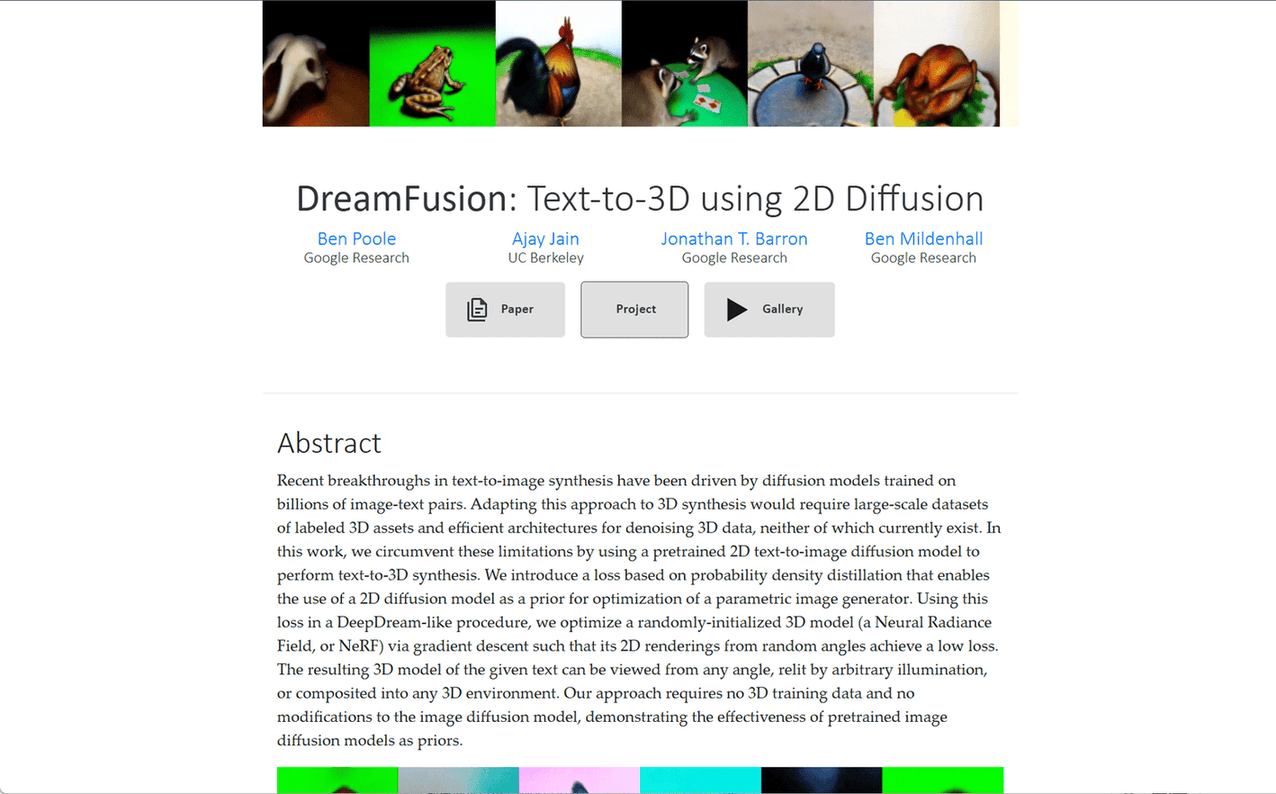
DreamFusion: Generating 3D Models from Text Descriptions
DreamFusion introduces a novel approach to creating high-quality 3D models using only text prompts, eliminating the need for any 3D training data. It redefines how 3D content can be generated, streamlining workflows in various creative and technical fields.
Key Features
-
Text-to-3D Generation
The system converts natural language descriptions into detailed 3D representations, enabling intuitive content creation. -
No 3D Training Data Required
By leveraging pre-trained 2D text-to-image diffusion models, DreamFusion bypasses the need for labeled 3D datasets. -
NeRF-Based Scene Representation
It uses Neural Radiance Fields (NeRF) to represent 3D scenes, offering photorealistic rendering from multiple viewpoints. -
Score Distillation Sampling (SDS)
A key innovation, SDS defines a loss function that allows 2D diffusion models to guide the optimization of 3D scenes, distilling the 2D model’s knowledge into a 3D structure. -
Mesh Export Capability
Once the 3D scene is generated, it can be converted into mesh format using the marching cubes algorithm, allowing integration into standard 3D workflows.
Applications
DreamFusion’s ability to synthesize 3D content from text unlocks possibilities across many domains:
-
Game Development
Enables rapid asset generation directly from creative narratives or design documentation. -
Virtual and Augmented Reality
Supports dynamic generation of objects and environments for immersive experiences. -
Film and Animation
Accelerates prototyping and concept development for scenes and characters. -
Product and Industrial Design
Facilitates visualization of ideas described in briefs or early-stage concepts.
Conclusion
DreamFusion represents a transformative step in digital content creation, bridging the gap between language and 3D visualization. Its integration of diffusion models and NeRF technology provides a flexible, efficient tool for generating high-quality 3D assets from simple text inputs, making it valuable across entertainment, design, and virtual world development.
data statistics
Relevant Navigation