



DanKoe, a millionaire internet celebrity, teaches you how to make money. 4 hours a day, one-man company, no employees needed, earning millions of dollars a year. How does he do it?
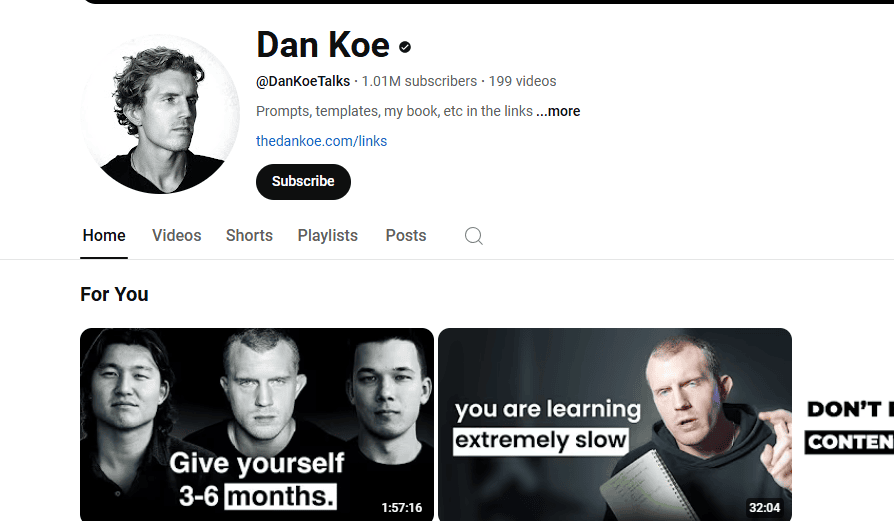 Working only 4 hours a day, without relying on luck or innate talent, and earning millions of dollars as a one-person company is not a pipe dream. Dan Coe, the YouTube giant with millions of followers, is a living example of this. He says, “Turn your life into an addictive video game—work only 4 hours a day, and you can earn millions even on your own.” Today, we’re going to break down Dan Coe’s entrepreneurial journey, learn about his 4-hour work theory and the business models suited for ordinary people, and see how he discovered effective products and leveraged social media for rapid promotion. It turns out that once you master the right methods, making money can be surprisingly easy.
Dan Coe’s entrepreneurial journey can be divided into three phases:
Phase 1: The Exploration Phase
During this period, he learned new skills and explored his interests in an effort to achieve the lifestyle many dream about—like those images you see on TV or online of people working on their laptops from the beach, or even not working at all. You might then ask, “Okay, so what should I do?” Right from the start, Dan knew he didn’t want a traditional lifestyle. However, he also understood that to escape the nine-to-five grind, he needed to acquire a skill that could generate a steady income even when he wasn’t actively working. At that time, he hadn’t yet decided what exactly to do, so throughout his college years, he experimented with various possibilities to find his passion—ranging from web design and digital art to programming and other projects.
At 18, his passion for fitness led him to create a fitness YouTube channel with friends, marking his first foray into social media. His “10,000-Calorie Challenge” video unexpectedly garnered over 20,000 views, which both delighted and surprised him. However, after a few months, he grew tired of it and abandoned the channel. A year later, in his sophomore year, he became fascinated with photography, teaching himself the craft on YouTube. He bought a camera with money earned from summer jobs and began taking photos everywhere. Spending six to eight hours daily processing images and posting them on Instagram, he unexpectedly accumulated over 2,500 followers. Yet, a few months later, he grew bored once again. This time, though, he realized that high-quality content has tremendous potential on social media, as it can be used to attract customers. Even if his efforts seemed short-lived, every brief period of focus was purposeful and helped him narrow down what he truly wanted to do.
Phase 2: The Advancement Phase
Next, Dan began exploring business models. In addition to learning new skills, he started studying business knowledge in order to monetize his abilities. His first attempt was in dropshipping. Believing in the profitability of e-commerce, he invested in courses on Facebook advertising and e-commerce to learn about ad placement and brand promotion, while continually searching for the right products to act as a direct sales agent.In his sophomore year, he accidentally attended a friend’s party and learned that there was a huge demand and promising market potential for party costumes. Targeting this segment, he spent $100 on advertising and successfully sold his first product, earning his first bucket of gold in his online business. This small success deepened his understanding of sales and branding, and gradually clarified the commercial logic for him.
After his initial success, he gained immense confidence and decided to create a genuine brand. When blue light glasses were very popular upon his college graduation, he decided to pursue that direction. He borrowed a few thousand dollars from his father to start building a blue light glasses brand, heavily invested in advertising, and reached out to bloggers for promotion. Unfortunately, a few months later, he exhausted all his funds and maxed out his credit card, yet the project still failed to gain traction. He became very disheartened. With no financial support, he was forced by life’s pressures to take a job in web design and returned to the workforce.
Minimalism doesn’t mean owning less; it means creating space for what truly matters. We must avoid pseudo-effort—for instance, if you want to learn photography but only watch tutorial videos without ever practicing, your progress will be slow and inefficient. You need to understand that the key lies in mastering skills and leveraging them, not merely focusing on the number of hours worked. For example, he prioritizes his most critical tasks during the first hour of work and limits his work time to just 4 hours a day.
The remaining time is allocated to managing communities and interacting with clients, a time management strategy that not only keeps him highly efficient but also leaves enough room to adapt flexibly to changes.
Second, turn your problem-solving strategies into your own products. For many beginners, creating a product or service is the hardest part—deciding what to do and how to do it can be overwhelming. Dan, however, shares his own experiences with product creation. He says that the most lucrative niche is yourself; don’t overcomplicate your product. Everything in life has the potential to become a product. For instance, if you’ve consistently worked out and achieved great results, you could try becoming a fitness coach or selling workout plans. If you’ve recently been studying English and passed an exam like the IELTS, you could start offering English consultation courses. Whether it’s photography, cooking, or painting—any pain or challenge you’ve experienced can become the solution or product you offer.
Third, use social media to promote your products. Once you have a product, you need to drive traffic, and today self-media is undoubtedly the most suitable channel for promotion. In our modern society, all industries are moving toward digitalization, and our lives are inseparable from the internet. Research shows that 30% of teenagers and 54% of adults in the U.S. express a desire to become YouTubers, and more and more people are discovering the money-making opportunities in self-media—it’s practically a zero-cost, one-person startup pathway.
I found that in creating videos, building a following, and learning about social media, I could attract an endless stream of clients. Dan also built his first wave of fans through social media to promote his products. He believes that the most important aspect of self-media is attracting and converting customers. To achieve this, he employs several marketing strategies, such as recommending that people start with writing—since many aspire to be YouTubers, but producing videos has a higher barrier to entry, whereas writing is accessible to almost everyone and involves no startup costs. Dan actually started writing on Twitter; he didn’t spend much time on images or videos, but instead observed trending topics on the platform, recorded his thoughts on subjects he was capable of writing about, and added his commentary. In reality, the foundation of any text, image, or video content is words.
Dan has always believed that a creator is like a DJ with unique ideas—your voice represents your worldview, expressed through your goals, problems, and experiences. That’s why a person can be a multifaceted market on their own. We collect trending topics, transform them from our perspective into unique ideas, and naturally attract like-minded people.
Furthermore, treat social media like a game. It functions as both a multiplayer and a single-player game. As a single-player, you must continually learn and refine your skills—from product design to sales and operations—treating yourself as a super-individual. As a multiplayer participant, you need to build connections by sending private messages to potential collaborators and using group chats to consolidate your fan base. Over time, this forms a tribal community within the game, which is the foundation for building your internet business.
Related posts
