



Exa.ai
Innovative AI search engine platform
Tags:AI Search EngineDeveloper Tools link-graph technology real-time web search scalable research API semantic search engine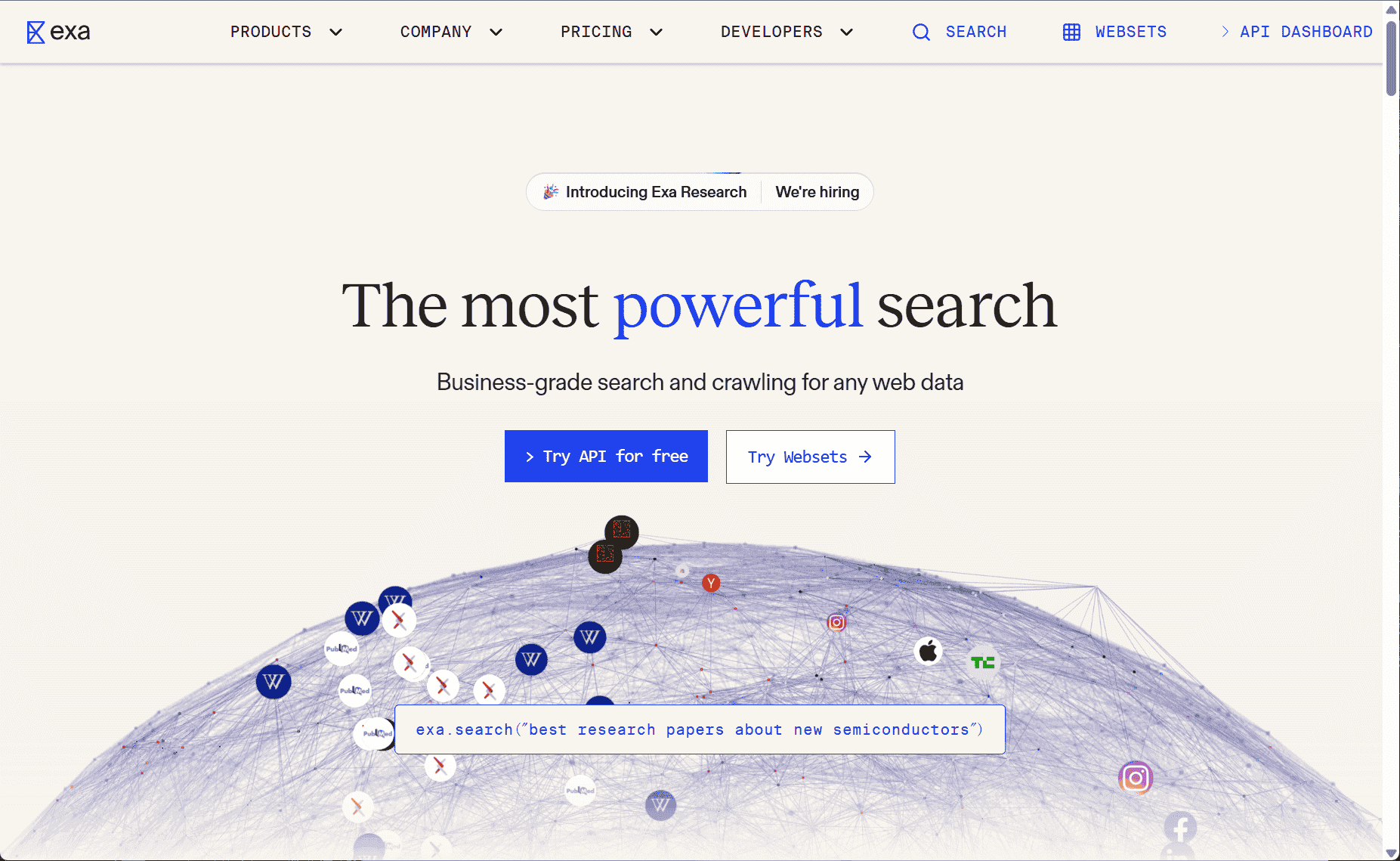
Exa’s Mission & Positioning
Exa is a next-generation web search solution designed specifically for systems that require high-quality, real-time information. Unlike traditional keyword-based search engines, Exa uses advanced methods such as semantic understanding, link-graph analysis, and next-link prediction to surface highly relevant results. It aims to be a “perfect search engine” for machines, offering an ad-free, noise-free environment with full control over data quality.
Core Technology & Features
-
Neural + Keyword Search (“Auto” Mode): Exa intelligently blends keyword-based search with semantic embedding-based search. A routing system determines the best method for each query—for instance, using keyword search for exact names and embedding methods for broader thematic searches.
-
Link-Graph & Next-Link Prediction: Rather than relying solely on raw text indexing, Exa uses web page relationships—analyzing over 50 billion links—to identify content that is contextually most relevant, enhancing search precision.
-
Rich API Tools: Exa offers a modular API suite:
-
/search: Finds relevant links. -
/contents: Retrieves clean page content. -
/findsimilar: Locates semantically similar documents. -
/answer: Provides direct responses. -
/research: Conducts multi-step research tasks with structured output.
-
-
Scale & Freshness: Capable of crawling tens of thousands of pages per minute, Exa delivers real-time results at scale. Users can filter by domain, date, and content type, and fetch up to one million results per query.
Use Cases & Integrations
-
RAG-powered Applications
Exa provides live data sources for reducing hallucinations in large language models and chatbots, ensuring responses are grounded in real-time information. -
Research & Market Intelligence
The/researchendpoint enables automated information gathering and synthesis across the web, useful for business intelligence and competitive analysis. -
Developer & Enterprise Tools
Developers can easily integrate Exa’s capabilities using tools likeexa_pyto add semantic search, content scraping, and similarity lookup functionalities. -
Custom Knowledge Pipelines
Organizations use Exa to build specialized knowledge graphs and domain-specific indexing workflows to power internal tools and research engines.
Company Background
Exa was founded in 2020 by Will Bryk and Jeff Wang. The company is headquartered in San Francisco. It has raised substantial venture capital funding from top investors, including Lightspeed and Nvidia’s corporate venture arm, and is also a Y Combinator graduate.
Recent Launch: /research Endpoint
In June 2025, Exa launched its flagship /research API, which enables fully autonomous web research. The system plans queries, executes searches, interprets results, and delivers structured insights along with citations. This endpoint achieves high accuracy and is optimized for low-latency, large-scale applications.
What Sets Exa Apart
| Differentiator | Description |
|---|---|
| Machine-first Design | Engineered for software systems rather than human browsing |
| Link Intelligence | Surfaces pages based on contextual relevance and link paths |
| Modular API | Offers flexible tools for search, retrieval, and analysis |
| Scalable Infrastructure | Supports massive, real-time crawling and indexing |
| Focused Model | No ads, no distractions—purely designed for data utility |
Conclusion
Exa redefines what modern web search can be by focusing on semantic understanding, graph-based discovery, and developer-first APIs. It delivers clean, scalable, and accurate web data for a wide range of applications—from AI systems to business research—making it a powerful platform for those who demand precision and performance in digital information discovery.
data statistics
Relevant Navigation