



James Webb Space Telescope: Reaching the Once-Inaccessible Corners of the Universe
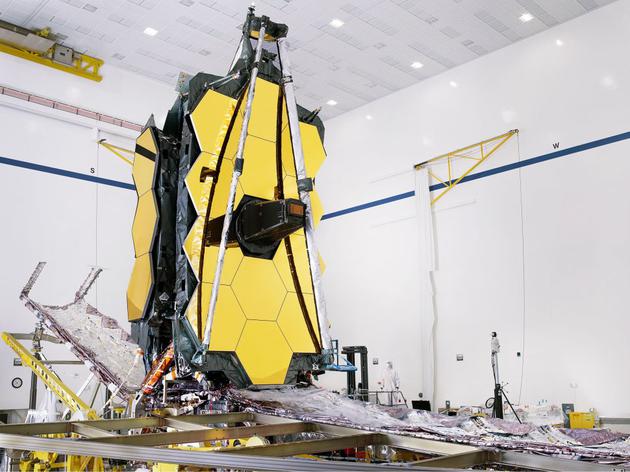
The assembled James Webb Space Telescope (including its “sunshield” and modular components) has completed some configurations and will undergo further installations.
According to media reports, NASA‘s James Webb Space Telescope is currently scheduled for launch in March 2021. Prior to this, the project has faced years of delays and billions of dollars in funding. Despite the significant investment of time and money, this telescope will undoubtedly become the “king” in the infrared spectrum, allowing us to finally reach the distant corners of the universe that were once out of reach.
From the first galaxies formed after the birth of the universe to the possibility of extraterrestrial life, the James Webb Space Telescope, with an investment of around $9.7 billion, will be our only hope for further exploring the wonders of the universe.
Not afraid of the cold
Although the James Webb Space Telescope (JWST) is hailed as the “successor” to NASA’s legendary Hubble Space Telescope, this is not entirely accurate. Hubble is primarily an optical telescope, capturing light within a wavelength range similar to that of the human eye, with only slight extensions into the infrared and ultraviolet bands. Essentially, the Hubble Telescope functions like a giant eyeball orbiting in space, continuously transmitting stunning images. If your visual sensory system were as powerful as its instruments, you would be able to witness these amazing sights firsthand.
However, the James Webb Space Telescope is different. It will observe entirely in the infrared spectrum, barely touching the “reddest” wavelengths visible to the human eye. In other words, it will explore a universe that is almost invisible to us.
One of the main reasons the James Webb Space Telescope is designed this way is that conducting infrared observations from the Earth’s surface is very challenging. To make accurate observations and measurements, astronomers must ensure the sky is completely clear, but light pollution on the ground severely limits the observational conditions.
Infrared light pollution is everywhere because any object with a temperature emits infrared radiation. The human body can generate 100 watts of infrared radiation. The Earth itself is also quite warm, making it appear bright in the infrared spectrum. Even the telescope itself emits infrared radiation at room temperature.
In conclusion, it’s not that we can’t conduct infrared astronomical observations from the ground, but the difficulty is immense. Therefore, we chose to place the James Webb Space Telescope in space.
Travel far from home
To avoid the impact of Earth’s infrared radiation, the James Webb Space Telescope will operate 1.5 million kilometers away from Earth. Despite being so far from Earth, the Sun remains a problem. You’ve probably felt the scorching summer sunlight—that’s infrared radiation. Even millions of kilometers away from Earth, the Sun’s heat is still significant.
To address this, the designers of the infrared space telescope have several possible solutions. One of the most common is to use an active cooling system to lower the telescope’s temperature to a level suitable for observing infrared wavelengths. This is a good method and has been used in other infrared space telescopes. However, it does limit the telescope’s operational lifespan, as once the coolant runs out, astronomical observations can no longer continue.
Therefore, the James Webb Space Telescope will take a unique approach by being equipped with an expensive giant “space umbrella.” This “umbrella” is 22 meters long and 11 meters wide, made of five layers of highly reflective material, each layer thinner than the diameter of a human hair. This massive “sunshield” will keep the telescope permanently in the shadow, with temperatures not exceeding -223°C, making it ideal for observing in the target infrared wavelength range.
However, one of the instruments on the telescope will use an active cooling system to lower its temperature to -258°C, allowing it to detect longer infrared wavelengths.
The power of science
In summary, the James Webb Space Telescope is massive and cannot fit into a single rocket. In addition to the giant sunshield, its primary mirror has a diameter of 6.5 meters, far exceeding the diameter of any rocket currently in use. Since the mirror couldn’t be attached to the side of the rocket, the clever NASA engineers decided to divide it into 18 smaller hexagonal segments. This way, it could be folded along with the sunshield and other components of the telescope to fit inside the rocket.
If all goes well, a few days after the launch, the James Webb Space Telescope will head toward its observation point, deploy its mirror and sunshield, and then begin its observation tasks.
Its observational results will be truly remarkable. One of the main observation targets of the telescope will be the early universe, just a few hundred million years after its birth. The first stars and planets emitted dazzling light in the visible spectrum. However, over the past 13 billion years, as the universe expanded, the wavelengths of these lights stretched, eventually moving beyond visible light and into the infrared spectrum, which happens to be the ideal observation range for the James Webb Space Telescope.
Since the first generation of stars and galaxies left no images behind, this will be our first time observing this crucial period in the history of the universe.
The James Webb Space Telescope will study all “cold” objects in the universe, including protoplanetary disks around newborn stars, molecular clouds, comets, the Kuiper Belt, and more.
The telescope will also use a special device to block out the light from some distant stars, allowing it to capture images of any objects passing in front of them, such as exoplanets. These planets appear very bright in the infrared spectrum, and by analyzing the light they emit, we can study the chemical substances and elements in their atmospheres, potentially discovering signs of life.
In conclusion, from searching for extraterrestrial life to uncovering the secrets of the universe’s dawn, the James Webb Space Telescope will undoubtedly live up to the years of anticipation.
Related posts
